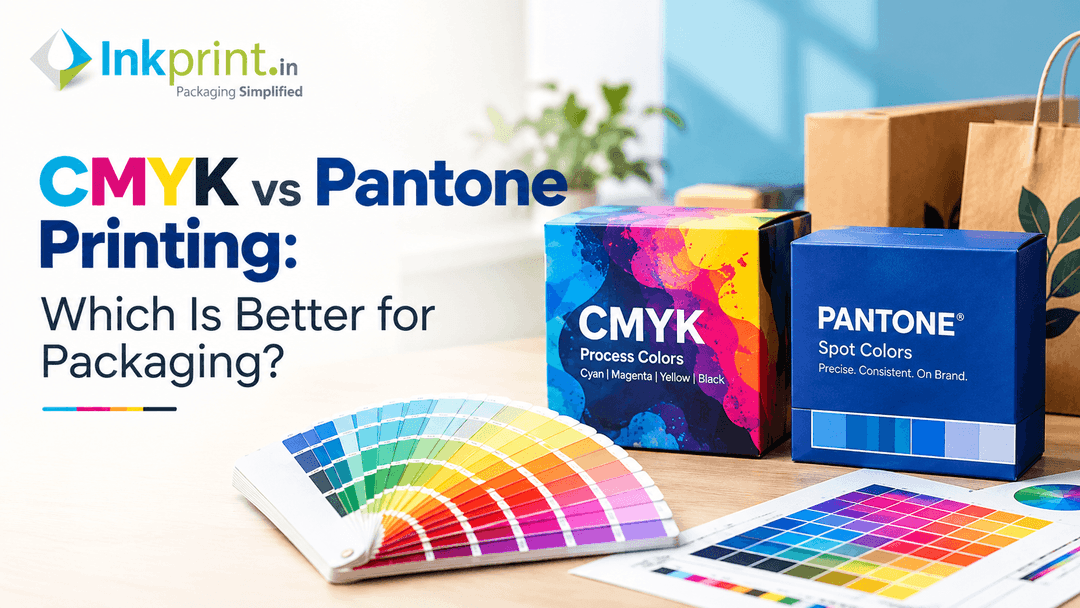
CMYK vs Pantone Printing: Which Is Better for Packaging?
Inkprint Team
Published: September 17, 2026
When it comes to packaging, color is more than just a design element. The right colors can make your product recognizable, reinforce your brand identity, and create a consistent look across boxes, labels, bags, and other packaging materials.
But choosing the right printing color system can be confusing. Should you use CMYK or Pantone? What is the difference between them? And which one is better for packaging printing?
Understanding CMYK vs Pantone printing can help you make the right choice before sending your packaging artwork for production.
In this guide, we'll explain how CMYK and Pantone printing work, compare their differences, and show when each option may be suitable for different packaging requirements.
What Is CMYK Printing?
CMYK stands for Cyan, Magenta, Yellow, and Key (Black). It is a process-color printing method that uses combinations of these four inks to create a wide range of colors.
CMYK is commonly used for designs containing photographs, illustrations, gradients, detailed graphics, and multiple colors.
For example, a printed packaging design may include a product photograph, colorful background, text, illustrations, and several shades. Instead of requiring a separate ink for every color, CMYK uses four process colors to reproduce the artwork.
This makes CMYK a practical option for many types of packaging designs.
CMYK printing is often suitable for:
Product photographs
Detailed illustrations
Colorful packaging artwork
Gradients and shadows
Multi-color designs
Promotional packaging graphics
Inkprint offers custom packaging products where full-color CMYK printing can be used depending on the product and specifications. For example, its classic product boxes offer one-side or both-side CMYK printing options.
If you're planning packaging for an e-commerce brand, you can also explore Inkprint's custom mailer boxes for branded shipping and unboxing applications.
What Is Pantone Printing?
Pantone printing generally refers to the use of Pantone spot colors.
Unlike CMYK, which creates colors by combining four process inks, a Pantone spot color uses a specific ink formulated to represent a selected color from the Pantone system.
This can be useful when a particular color is an important part of a brand's identity.
For example, a company may have a distinctive logo color that needs to be specified consistently across different printed materials. In such cases, a spot-color approach may be considered instead of relying entirely on a CMYK conversion.
Pantone spot colors can be useful for:
Brand colors
Logos
Simple packaging designs
Designs using a limited color palette
Projects where a particular color needs careful specification
However, the appearance of a printed color can still vary depending on the substrate, ink, coating, printing process, and viewing conditions. Therefore, Pantone should not be treated as a guarantee that a color will look identical in every production environment.
CMYK vs Pantone Printing: What Is the Difference?
The biggest difference between CMYK and Pantone is how the color is produced.
Feature | CMYK Printing | Pantone Printing |
|---|---|---|
Printing method | Process color | Spot color |
Main colors | Cyan, Magenta, Yellow, Black | Specific pre-mixed color |
Best suited for | Complex and multi-color artwork | Specific colors and brand colors |
Photographs | Excellent choice | Generally less practical |
Gradients | Suitable | More limited |
Color matching | Based on process reproduction | Based on a specified spot-color reference |
Number of inks | Four process colors | Separate ink for each spot color |
Packaging use | Boxes, labels, bags and detailed artwork | Brand colors and specific spot-color requirements |
Neither option is automatically better for every packaging project.
The right choice depends on your artwork, packaging material, printing process, number of colors, quantity, and how important a particular color is to your brand.
CMYK vs Pantone for Packaging Printing
Packaging presents some unique color challenges.
The same artwork can look different depending on whether it is printed on coated paper, kraft paper, cardboard, corrugated material, plastic film, or another substrate. Finishes such as matte or gloss lamination can also affect the visual appearance.
This is particularly important for brands that want packaging to look consistent across different products.
Inkprint provides a range of custom packaging formats, including monocarton boxes, mailer boxes, printed shipping boxes, pouches, labels, packaging sleeves, paper bags, and food-delivery packaging.
For each project, the appropriate printing approach should be considered alongside the material and finishing requirements.
For example:
A photographic product box may benefit from CMYK process printing.
A simple design centered around a particular brand color may require consideration of spot colors.
A kraft-paper package may have a different visual appearance from a coated white package.
A package with matte or gloss finishing may display colors differently.
That's why it's useful to discuss important color requirements with your packaging printer before production.
When Should You Choose CMYK for Packaging?
CMYK can be a practical choice when your packaging design contains many colors or detailed visual content.
1. Your packaging contains photographs
Photographic images contain thousands of visual color variations. CMYK process printing is designed to reproduce this type of artwork.
2. Your design contains gradients
Gradients, shadows, highlights, and smooth transitions can be efficiently handled through process-color printing.
3. Your artwork uses many colors
If your packaging contains several colors, illustrations, images, and other visual elements, CMYK can be a practical production method.
4. You need full-color packaging
Many packaging designs require full-color reproduction rather than just one or two spot colors.
Inkprint's product packaging options include CMYK printing on selected products. Its custom packaging sleeves, for example, support CMYK multicolor printing for single- or double-sided designs.
You can explore custom packaging sleeves if you're looking for a flexible way to add branding to existing packaging.
When Should You Choose Pantone for Packaging?
Pantone spot colors can be worth considering when a specific color plays an important role in your brand identity.
Suppose your logo uses a distinctive color that customers associate strongly with your brand. In that case, specifying the color carefully can be an important part of your packaging strategy.
Pantone may be considered when:
A particular brand color is critical.
The artwork uses a limited number of colors.
Color consistency is an important production requirement.
The packaging design is relatively simple.
Your printing supplier supports the required spot-color process.
However, the decision should always be made with your printer because printing capabilities and processes vary.
For packaging products such as labels, sleeves, boxes, bags, and tags, the printing requirements may differ depending on the material and production method.
Is Pantone More Accurate Than CMYK?
This is one of the most common questions when comparing CMYK vs Pantone printing.
The answer depends on what you mean by "accurate."
Pantone spot colors provide a standardized reference for specifying a particular color, while CMYK creates colors through combinations of four process inks.
If you need to reproduce a specific brand color, a Pantone spot-color specification can provide a useful reference for production.
However, the final printed result can still be influenced by:
Printing equipment
Ink
Packaging substrate
Coating
Lamination
Lighting
Proofing conditions
Therefore, neither system should be viewed in isolation.
For critical packaging colors, discuss the requirements with your printer and consider reviewing a physical proof before approving a large production run.
Can Pantone Colors Be Converted to CMYK?
Yes, Pantone colors can be cross-referenced or converted to CMYK equivalents.
However, a conversion doesn't necessarily mean that the CMYK version will look exactly the same as the original Pantone spot color.
The reason is simple: CMYK and Pantone use different approaches to producing color. Some Pantone colors may also fall outside what can be reproduced using a particular CMYK process.
This is particularly important for packaging designs where brand-color consistency matters.
If you're converting an existing Pantone-based design to CMYK, check the result before production and communicate any critical color requirements to your printer.
For packaging projects, don't rely solely on how a color appears on your computer monitor. A screen uses light to display color, while printed packaging uses ink or other physical colorants on a substrate.
How to Choose Between CMYK and Pantone for Packaging
Still unsure which option to use? Consider these factors before finalizing your artwork.
Consider Your Artwork
Start with the design itself.
If it contains photographs, gradients, illustrations, and many colors, CMYK may be a practical option.
If the design uses a small number of specific colors, particularly a distinctive brand color, discuss spot-color options with your printer.
Consider Your Brand Identity
If your brand relies heavily on a particular color, make color consistency part of the packaging discussion from the beginning.
Your packaging may include several printed elements, such as:
Product boxes
Shipping boxes
Labels
Sleeves
Bags
Hang tags
Stickers
Keeping color specifications consistent across these applications can help create a unified visual identity.
Consider the Packaging Material
Material can have a significant effect on the appearance of printed colors.
A color printed on white coated paper may look different from the same color printed on brown kraft paper.
For example, Inkprint's packaging sleeves are available in silk-coated paper as well as brown kraft paper options, demonstrating why substrate selection needs to be considered alongside the artwork.
Consider Your Printing Process
Ask your packaging printer which color processes are available for your selected product.
Your printer can help determine whether CMYK, spot colors, or another printing approach is appropriate for the material and production requirements.
Consider Quantity and Budget
Don't assume that Pantone is always more expensive or that CMYK is always cheaper.
The final cost can depend on:
Quantity
Packaging size
Material
Number of colors
Printing process
Finishing
Lamination
Foiling
Embossing
Production setup
For example, Inkprint's classic product boxes offer additional finishing options such as coatings, lamination, foiling, and embossing.
Consider Proofing
If the exact appearance of a color is important, ask about proofing before committing to a large production run.
A physical proof gives you a more useful reference for how the artwork may appear on the actual packaging material than a digital screen alone.
Tips for Getting Consistent Packaging Colors
Choosing CMYK or Pantone is only part of achieving consistent packaging colors.
Follow these practical tips:
Use clear color specifications
Give your printer the exact color information required for the project.
Consider the substrate
Always consider the material on which the color will be printed.
Check the artwork before printing
Make sure images, color profiles, fonts, and other artwork elements are prepared according to your printer's specifications.
Request a proof for important projects
If your brand color is particularly important, consider reviewing a proof before full production.
Keep specifications consistent
When producing packaging repeatedly, maintain consistent artwork, materials, finishes, and production specifications wherever possible.
Communicate with your printer
If you have a critical brand-color requirement, tell your printer before production rather than expecting the requirement to be inferred from the artwork.
CMYK vs Pantone Printing for Different Packaging Types
Different packaging formats may have different printing requirements.
Product Boxes
Product boxes often contain logos, product information, illustrations, and sometimes photographs. CMYK can be useful for full-color artwork, while specific brand colors may require additional consideration.
Inkprint offers custom product boxes with full-color CMYK printing options and multiple material and finishing choices.
Mailer Boxes
Mailer boxes are particularly important for e-commerce brands because they can contribute to the customer's unboxing experience.
Inkprint's custom mailer boxes are designed for branded packaging and shipping applications.
Packaging Sleeves
Sleeves can add branding without requiring a completely new outer package. Inkprint offers customizable sleeves with CMYK multicolor printing and multiple paper options.
Food Packaging
Food businesses need packaging that combines branding with appropriate material and production considerations. Inkprint provides custom food delivery packaging including boxes, bags, pouches, and related packaging options.
Labels
Labels can contain logos, product information, colors, and promotional elements. When label color is important to your branding, discuss the appropriate printing process with your supplier.
Final Thoughts: CMYK vs Pantone Printing
Understanding CMYK vs Pantone printing can help you make smarter packaging decisions before production begins.
CMYK is well suited to photographs, gradients, detailed graphics, and designs containing many colors. Pantone spot colors can be useful when a particular brand color needs to be specified and carefully reproduced.
The right choice depends on your artwork, packaging material, printing process, quantity, finishing requirements, budget, and color expectations.
At Inkprint, businesses can choose from a broad range of packaging solutions, including mailer boxes, monocarton boxes, printed shipping boxes, standup pouches, labels, packaging sleeves, paper bags, and food delivery packaging.
If you're unsure which printing approach is appropriate for your packaging, discuss your artwork and requirements with a packaging printing professional before production.
Ready to create custom packaging for your brand? Explore Inkprint's custom packaging solutions and find the right packaging format for your product
Frequently Asked Questions
Get in Touch
Still have questions? Fill out the form below and our team will get back to you shortly.