Types of Corrugated Boxes: How to Choose Between 3 Ply, 5 Ply and 7 Ply
Inkprint Team
Published: October 28, 2026
Most damaged deliveries are not caused by bad couriers. They are caused by the wrong box.
A box that is too weak gets crushed at the bottom of a stack. A box that is too heavy-duty wastes money on every single order. The difference usually comes down to one number on the spec sheet: the ply.
Corrugated boxes come in three main types: 3 ply, 5 ply and 7 ply. Each extra layer adds strength and weight. 3 ply suits light products, 5 ply handles heavier or fragile items, and 7 ply is built for industrial loads. If you ship retail or e-commerce orders, you will almost always need one of the first two. You can see both in InkPrint's range of printed corrugated shipping boxes.
Here is how to tell which one your product actually needs.
What does "ply" mean in a corrugated box?
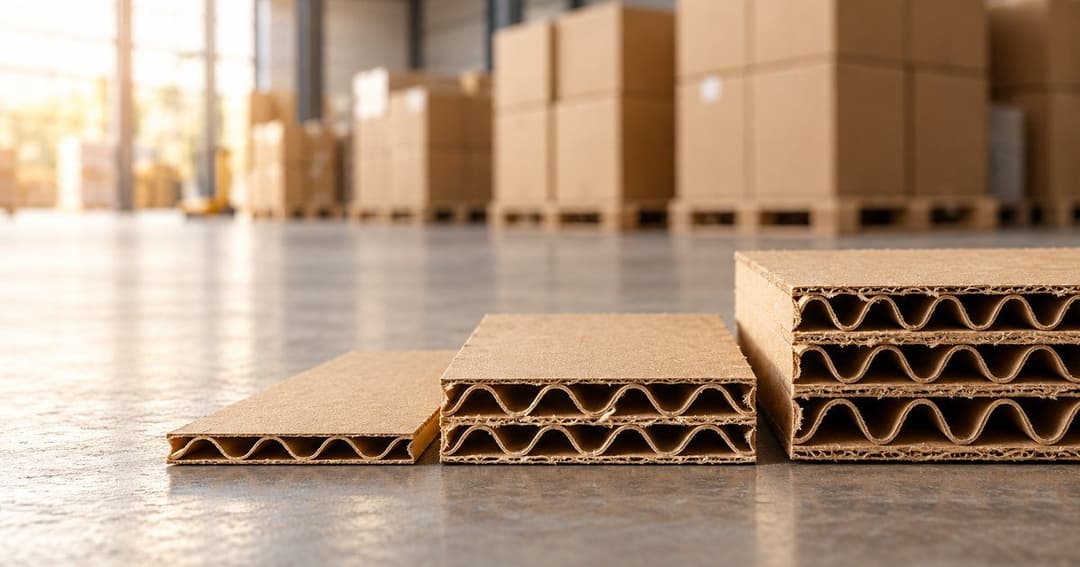
Ply is simply the number of paper layers in the board. Corrugated board alternates flat sheets (liners) with wavy sheets (flutes). The flutes work like tiny arches: they absorb shocks and keep the box rigid when other boxes are stacked on top.
- 3 ply = 2 liners + 1 fluted layer
- 5 ply = 3 liners + 2 fluted layers
- 7 ply = 4 liners + 3 fluted layers
More layers mean more stacking strength and better protection. They also mean more weight, more space and a higher price per box. The goal is not the strongest box. It is the right one.
3 ply vs 5 ply vs 7 ply at a glance
| 3 Ply | 5 Ply | 7 Ply | |
|---|---|---|---|
| Layers | 2 liners, 1 flute | 3 liners, 2 flutes | 4 liners, 3 flutes |
| Rough load guide* | Light items, up to about 5-7 kg | Medium to heavy, about 10-20 kg | Heavy industrial, 20 kg and above |
| Typical products | Apparel, cosmetics, books, accessories | Appliances, glassware, electronics, bulk packs | Machinery parts, large appliances, export cartons |
| Stacking | Light stacking | Warehouse stacking | Heavy, high stacks |
| Cost per box | Lowest | Medium | Highest |
| Best for | E-commerce orders, retail packing | Fragile or heavy shipments, long distances | Industrial and export freight |
*A rough guide only. Real strength depends on the paper grade, the box size and how the box is packed.
When is a 3 ply box enough?
A 3 ply box is enough for most light e-commerce and retail shipments: clothes, cosmetics, books, accessories and small gifts. It is light, it keeps courier charges down, and it prints well, which makes it the most common choice for branded packing boxes.
Where 3 ply struggles is weight and pressure. Put a 9 kg mixer grinder in it, or leave it at the bottom of a warehouse stack, and the walls start to bulge. If your product is light but breakable, such as a glass candle jar, 3 ply can still work as long as nothing moves inside. Use an insert or filler so the product cannot shift.
InkPrint's 3 ply corrugated boxes are the usual starting point for D2C brands that ship every day.
When do you need 5 ply?
You need 5 ply when the product is heavy, fragile, valuable or travelling a long way. The second fluted layer makes the walls much stiffer, so the box holds its shape under stacking and rough handling.
Signs you have outgrown 3 ply:
- Boxes arrive with crushed corners or dented sides.
- Your product weighs more than a few kilos.
- Orders travel long routes with several hand-offs between hubs.
- Customers return items damaged in transit.
The extra cost of 5 ply is usually far smaller than the cost of one damaged return: the product, the reverse shipping and an unhappy customer.
Is 7 ply ever necessary?
7 ply is for industrial loads: heavy machinery parts, large appliances, bulk export cartons and goods stacked high in containers. It is very strong, and also heavy and expensive. Most retail and e-commerce brands never need it. If you are considering 7 ply for a consumer product, a well-fitted 5 ply box with proper inserts is usually the smarter buy.
Flute types: the detail most buyers miss
Two 5 ply boxes can behave very differently because of their flute size. Flutes are graded by letter, and the size changes both strength and print quality:
- A flute (thickest): the best cushioning and stacking strength.
- B flute: good puncture resistance and a flatter surface for printing.
- C flute: a balance of cushioning and strength, very common in shipping boxes.
- E flute (thin): a smooth surface for sharp printing, used for retail and mailer-style boxes.
5 ply and 7 ply boards often combine two flute types, for example B and C, to get strength and a good printing surface at the same time. When you ask a corrugated box manufacturer for a quote, ask which flutes they use, not just how many plies.
How to choose the right corrugated box: a 5-minute check
- How heavy is it, packed? Under about 5 kg, start with 3 ply. Heavier, go for 5 ply.
- Is it fragile? If yes, use 5 ply, or 3 ply with a snug insert.
- How far does it travel? Same city, 3 ply is fine. Across India with several hand-offs, 5 ply is safer.
- Will the boxes be stacked? Warehouse stacking needs 5 ply.
- Does the box need to sell, too? If unboxing matters, choose a board that prints well and add your logo. For very light items, a lighter mailer box may look better and cost less.
Get the size right as well. A box that is too big lets the product slide around, and that damages more parcels than a thin wall ever does.
Common mistakes brands make with corrugated boxes
- Paying for 5 ply when 3 ply would do. It adds weight and courier cost on every order.
- Choosing by ply alone. Paper quality matters too. Kraft paper is graded by GSM (weight) and BF (bursting factor), and a higher grade makes a noticeably stronger box at the same ply.
- Ignoring the inside. Inserts and dividers often protect better than an extra layer of board.
- Leaving boxes blank. A plain brown box does the job, but printed corrugated boxes turn every delivery into brand exposure, often for a small extra cost per box.
Still unsure which to pick? Start with one simple rule: light and local, 3 ply; heavy, fragile or far, 5 ply; industrial, 7 ply. Then size the box tightly to the product. If you want your boxes printed with your brand, browse InkPrint's printed corrugated shipping boxes and price them online in a few clicks.
Frequently Asked Questions
Get in Touch
Still have questions? Fill out the form below and our team will get back to you shortly.